In many homes today, Easter traditions are increasingly shaped by shop-bought decorations and the pace of modern life. But in the village of Dol, one woman has spent decades preserving a custom that still carries the patience, beauty and quiet meaning of older times.
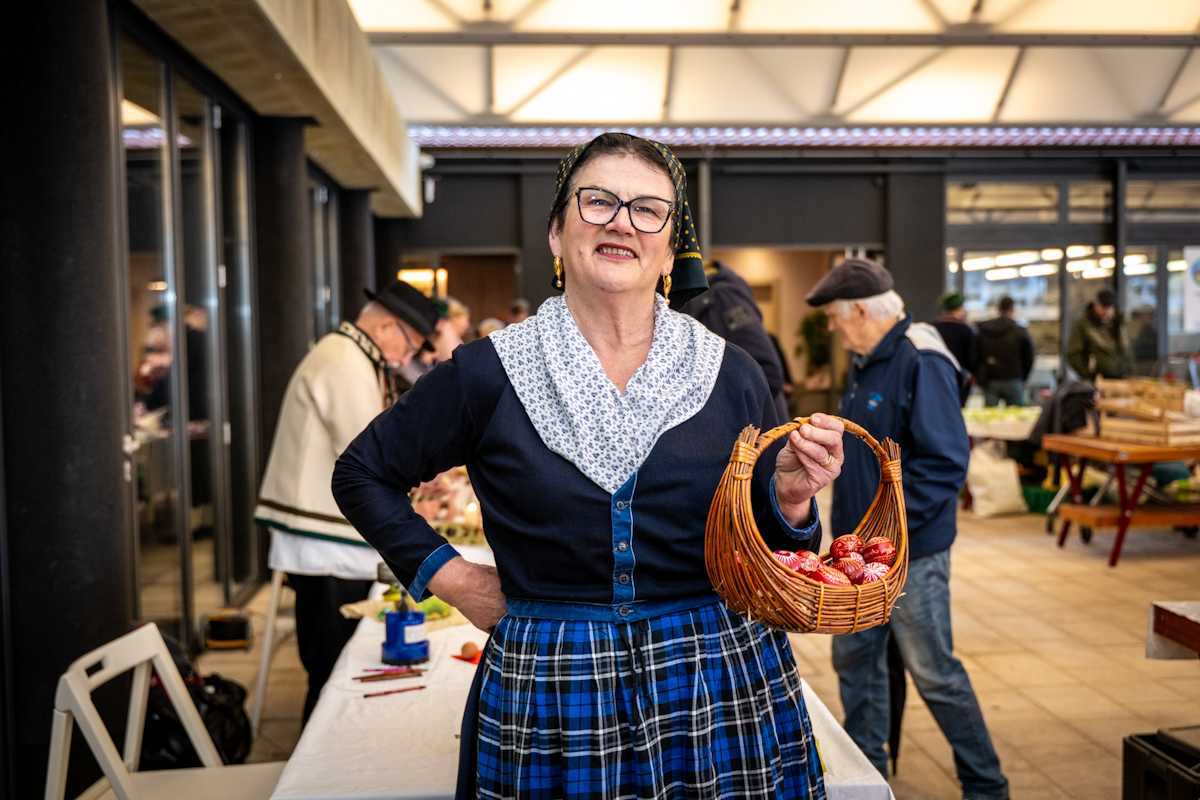
Jagoda Konjuh has long been devoted to penganje jaja, the traditional Dubrovnik-area custom of painting and decorating Easter eggs by hand.
Born in Čepikuće and living in Dol for the past 45 years, she is now retired after four decades of work in public service at the Institute for the Restoration of Dubrovnik. Retirement, however, has brought her anything but idleness.
Her days are still full: caring for grandchildren, sewing traditional costumes, helping with tourism and working the land. It is a life shaped by many small tasks, but also by a deep connection to customs she has never wanted to let disappear.
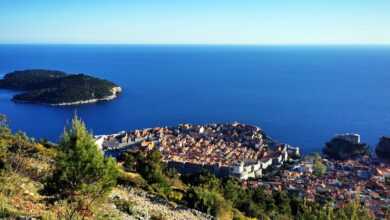
When she speaks about Dubrovnik itself, there is warmth in her voice, but also a sense of loss. Living in the countryside means she is no longer in the city as often as she once was, yet when she does pass through, she feels how much has changed. What she misses most is the former liveliness of the old centre — the sense of people gathering, meeting and sharing everyday life in the heart of the city.
That feeling matters to her because tradition, in her world, has never been something abstract. It lives through people, through repetition and through the small things that continue to be done, year after year.
Learned young, kept for life
Jagoda learned to paint Easter eggs as a young girl, while still in primary school. It was a skill passed down not in easy circumstances, but in a household shaped by hardship, resilience and responsibility.
Born in 1962, she lost both parents while still a child. She and her siblings were raised by their stepmother, who became, as Jagoda describes it, both the male and female head of the household. It was she who noticed Jagoda’s gift for working with her hands and chose her, among all the children, to learn this delicate Easter custom.
That early lesson became a lifelong practice.
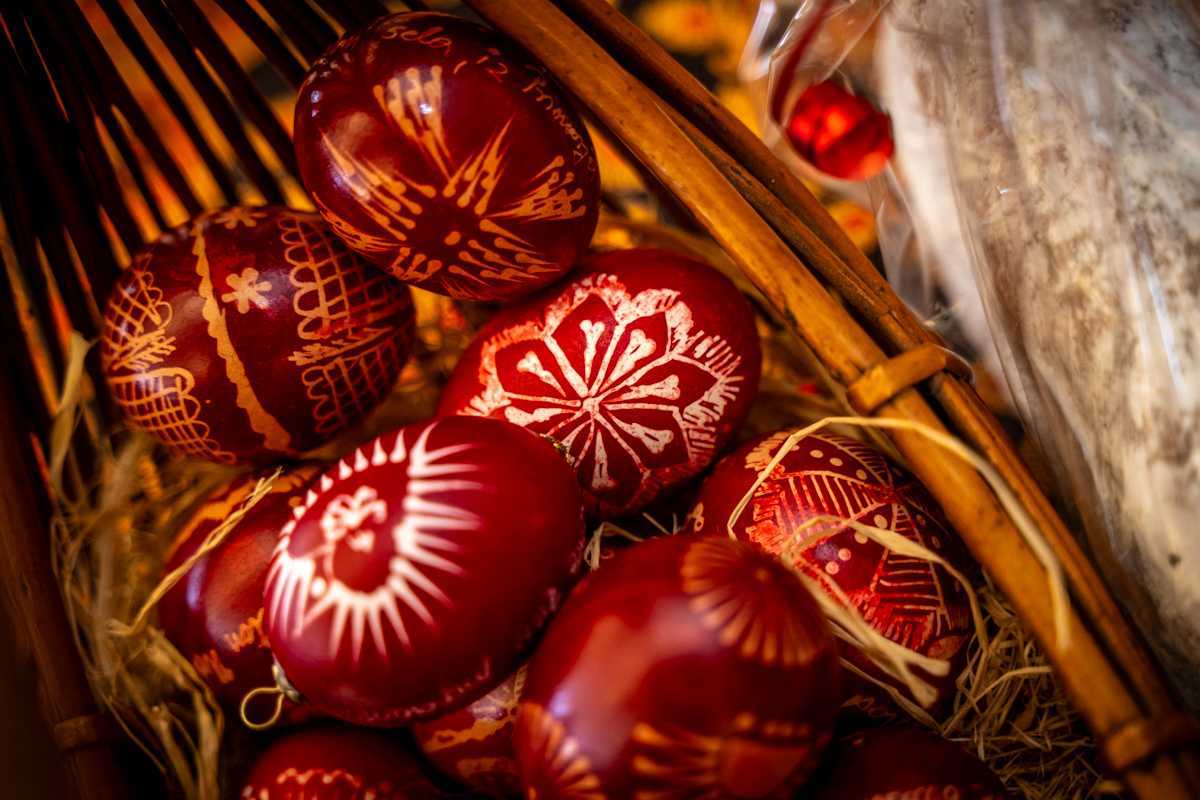
Since then, not a single year has passed without painted Easter eggs. Every Easter, Jagoda prepares them for children, neighbours, relatives, friends, brothers, sisters and extended family. Because hers is a large family, that means making many of them, not as decoration for display, but as something still woven into family life.
Why tradition still matters
For Jagoda, tradition is not just a gesture repeated out of habit. It is something valuable, something worth keeping and passing on.
She believes that if people stop making the effort to preserve what they have inherited, it is easily lost beneath the speed of modern life. Trends change quickly, new habits arrive constantly, and local customs are too easily pushed aside. That, in her view, is exactly why they need protecting.
She is not against modern life, nor does she believe everything old should remain unchanged. But she does believe that the old and the new should be able to coexist. Family feast days, village customs and church holidays, she says, should still include small rituals that give them meaning. It does not need to be elaborate. Even a few minutes of tradition tied to an important day can be enough to make people feel more connected, to their family, to their place and to one another.
Every egg takes patience
Painting Easter eggs in this traditional way is slow, detailed work. It demands calm, concentration and time set aside properly. It is not something that can be done in haste or between other tasks.
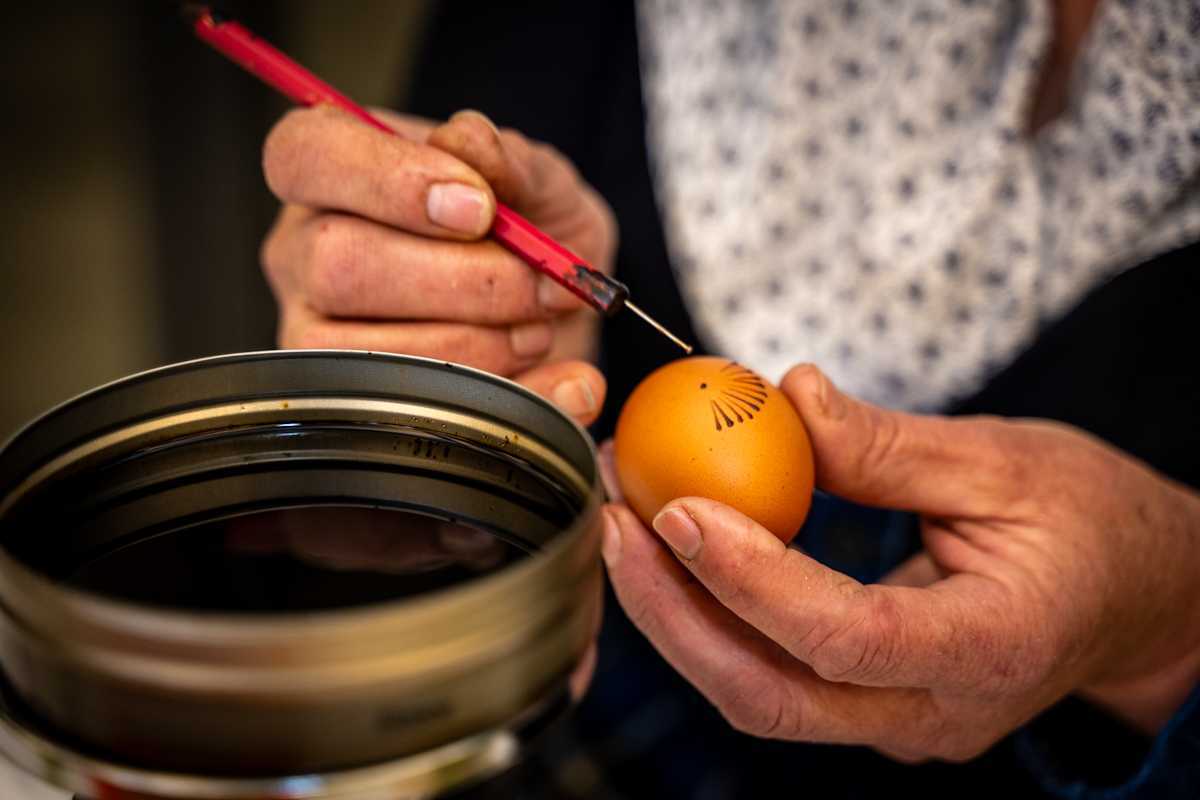
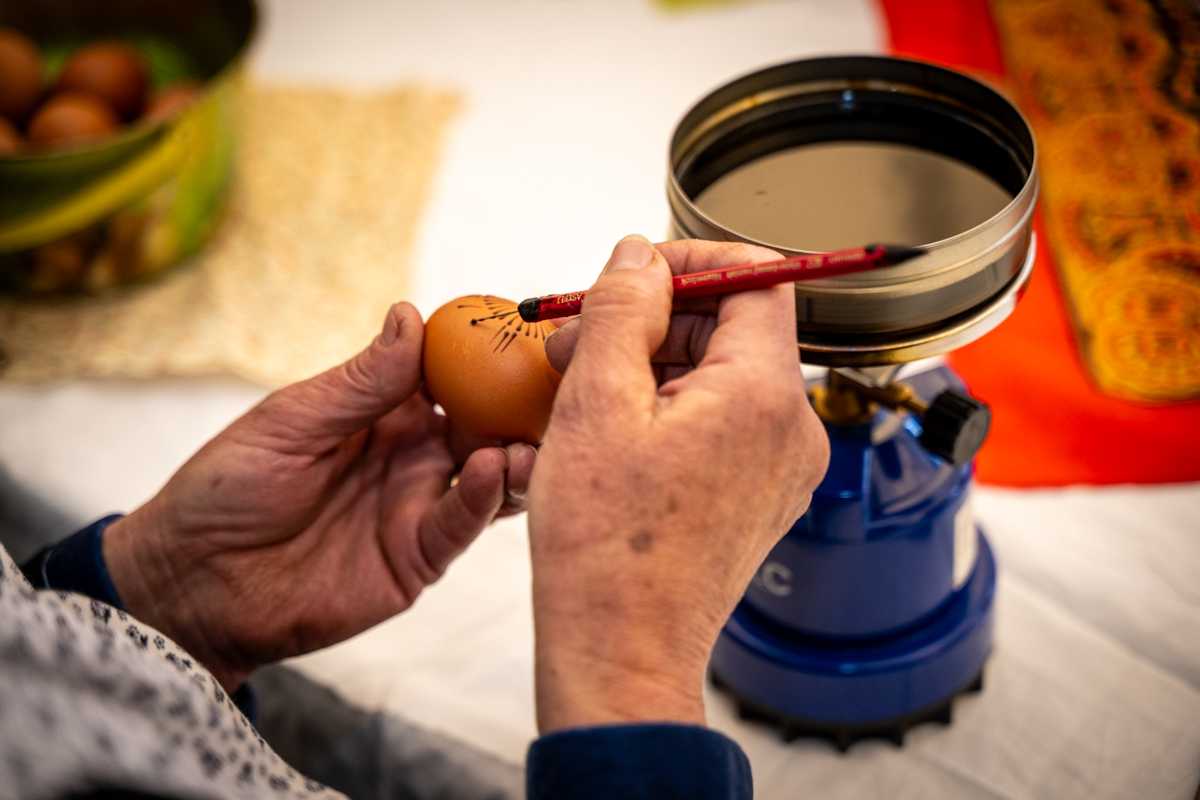
Jagoda explains that if she wants to decorate an egg properly, she needs about five minutes for a single one. Every dot is one movement. Every motif is formed stroke by stroke, using hot wax applied with a headed pin or a writing nib. Each mark must be made quickly, before the wax cools, and with great care, so that it falls exactly where it should.
Depending on the pattern, one egg can require anywhere from 150 to 250 separate hand movements.
Sometimes, she says, even she does not know exactly what she will draw. She follows the movement of her hand and lets the pattern emerge as she works. That is part of what gives these eggs their character: each one is made slowly, individually and with the quiet discipline of long practice.
People occasionally ask her how much such work would cost if sold. Her answer is always much the same — it is not something that can easily be measured. She also sews and knows well how demanding handwork can be, but for her, the effort and time that go into painting Easter eggs stand apart even from other forms of manual skill.
Old methods, easier conditions
The technique has remained the same, but the conditions in which it is done have changed greatly.
Jagoda remembers the beginnings well: an old pot balanced on her lap, ash and embers, and smoke everywhere through the house. It was work done in a darker, older domestic setting, one shaped by open fire, soot and improvisation.
Today, everything is simpler and cleaner. There is a cooker, less mess and more comfort, and the eggs can be decorated indoors far more easily. Yet despite those practical changes, the essence of the custom has remained untouched.
The timing, too, has shifted. In earlier times, she says, eggs were always painted during Holy Week. There was an understood order to things, and that was when life gradually turned towards Easter preparations.
Now she begins around fifteen days before Easter, simply because of the number she needs to make. Each year she prepares around two hundred painted eggs.
Natural colour, and no certainty
One of the most beautiful parts of the process is the colouring itself, which Jagoda still approaches in a natural way.
The eggs must first be washed so that they are clean. She decorates them while they are still raw, working directly on the shell before moving to the colouring stage. For the richest colour, she uses broć, a plant whose root gives a deep burgundy-red tone when cleaned and boiled. The result can be beautiful, but never entirely predictable.
Every egg is different, she says. The shell matters, its tone matters, even the amount of calcium matters. Not every egg turns out successfully, no matter how carefully it is made. But that, too, is part of the process. Life has its rises and falls, and so does this work.
A tradition that will continue
What matters most to her is that the tradition will not end with her.
Jagoda has six grandchildren. Two live in Zagreb, but the four at home have already shown real interest. Recently, the family organised a small workshop, and all of them tried decorating eggs themselves. They learned, and she believes the custom will continue in her family. That gives her a deep sense of fulfilment.
More broadly, she feels younger generations often struggle to find patience for this kind of work. Everything today moves faster, and many people want things immediately. Skills that demand time, repetition and attention can too easily seem unnecessary. Too much is bought, used briefly and discarded, while fewer people are willing to sit down and make something slowly with their own hands.
And yet, in her own family, she sees a different possibility. There, the interest is still alive.
That is why this Easter custom still matters. Not because it belongs only to the past, but because it continues to live wherever someone is willing to sit down, take the time and begin.
And in Dol, every Easter, that still happens.