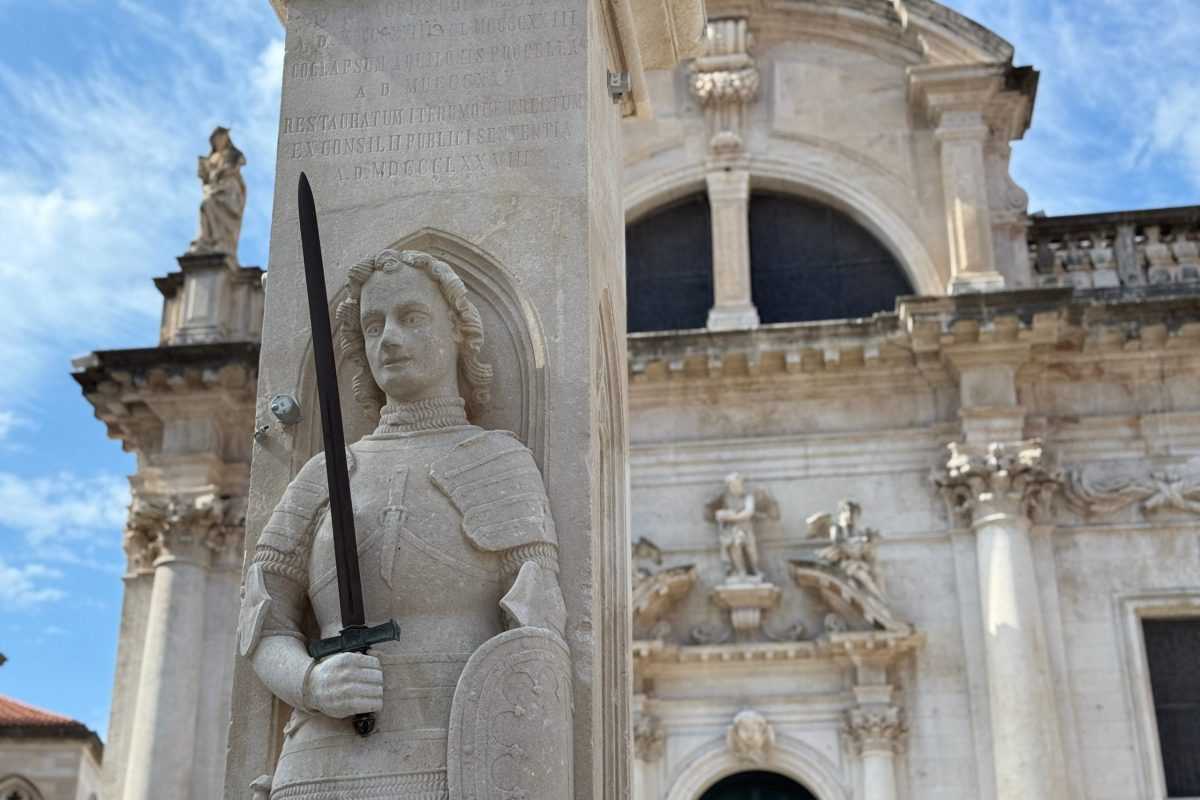
A familiar face back in the heart of the Old City
In a city where stone remembers almost everything, some moments feel quietly symbolic. Today, one of them happened in the very heart of Dubrovnik.
After years surrounded by scaffolding, Orlando’s Column is finally visible again. The working structure that had covered the famous monument in Luža Square has been removed, allowing locals and visitors to once more admire, photograph and stand near one of Dubrovnik’s most important symbols.
A low protective fence is now being installed around the column, not to hide Orlando, but to allow experts to continue monitoring the condition of the monument without the heavy scaffolding that had surrounded it for years.
For Dubrovnik, this is not just the return of a landmark. It is the return of a presence.
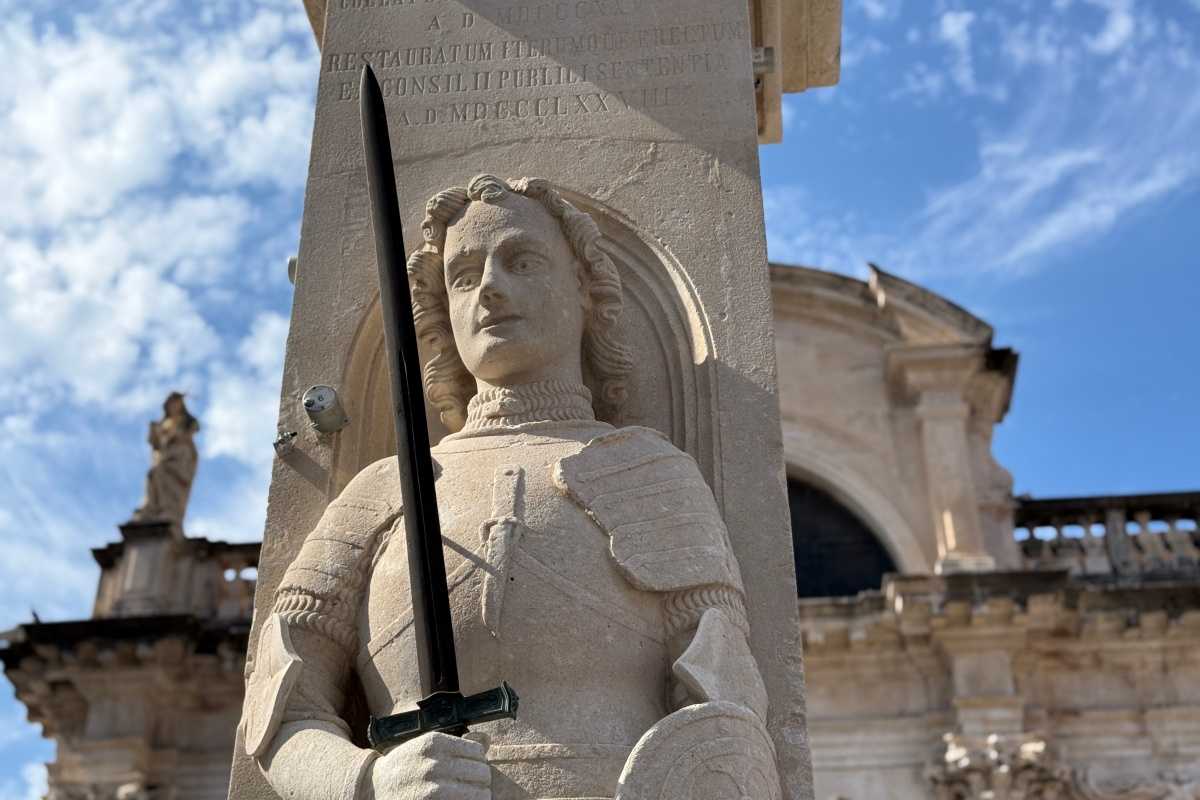
The knight who watched over Dubrovnik
Standing between Sponza Palace, the Church of St. Blaise and the City Bell Tower, Orlando has long been part of the city’s daily rhythm. Tourists stop in front of him. Children ask who he is. Locals pass by almost instinctively, knowing that the stone knight has always belonged there.
But Orlando is much more than a figure carved in stone.
The monument represents Roland, known in Dubrovnik as Orlando, the legendary medieval knight whose story travelled across Europe through literature, myth and civic symbolism. In Dubrovnik, Orlando became something deeply local: a guardian of the city’s idea of itself.
According to legend, he helped defend Dubrovnik from danger near Lokrum, saving the city in a time of threat. Whether legend or memory, the story gave Dubrovnik a powerful image: a knight standing upright, sword in hand, guarding a free city.
And in Dubrovnik, freedom has never been just an idea. It has always had a name — Libertas.
A symbol of freedom, public life and pride
For centuries, Orlando’s Column was not simply decorative. It stood at the centre of Dubrovnik’s civic life.
This was a place where public proclamations were made, where the city gathered, listened, celebrated and marked important moments. Orlando’s right forearm was also once used as a measure of length, known as the Dubrovnik lakat, a detail that connects the monument not only with history and ceremony, but also with everyday life, trade and the practical order of the old Republic.
Most importantly, Orlando became a symbol of Dubrovnik’s independence, autonomy and civic pride. His column carried the city’s flag, and that symbolic role continues today.
During the opening of the Dubrovnik Summer Festival, the raising of the Libertas flag near Orlando remains one of the most emotional images of the city’s cultural life. It is a reminder that Dubrovnik’s great story is not only told through walls, palaces and churches, but also through symbols that generations have continued to recognise as their own.
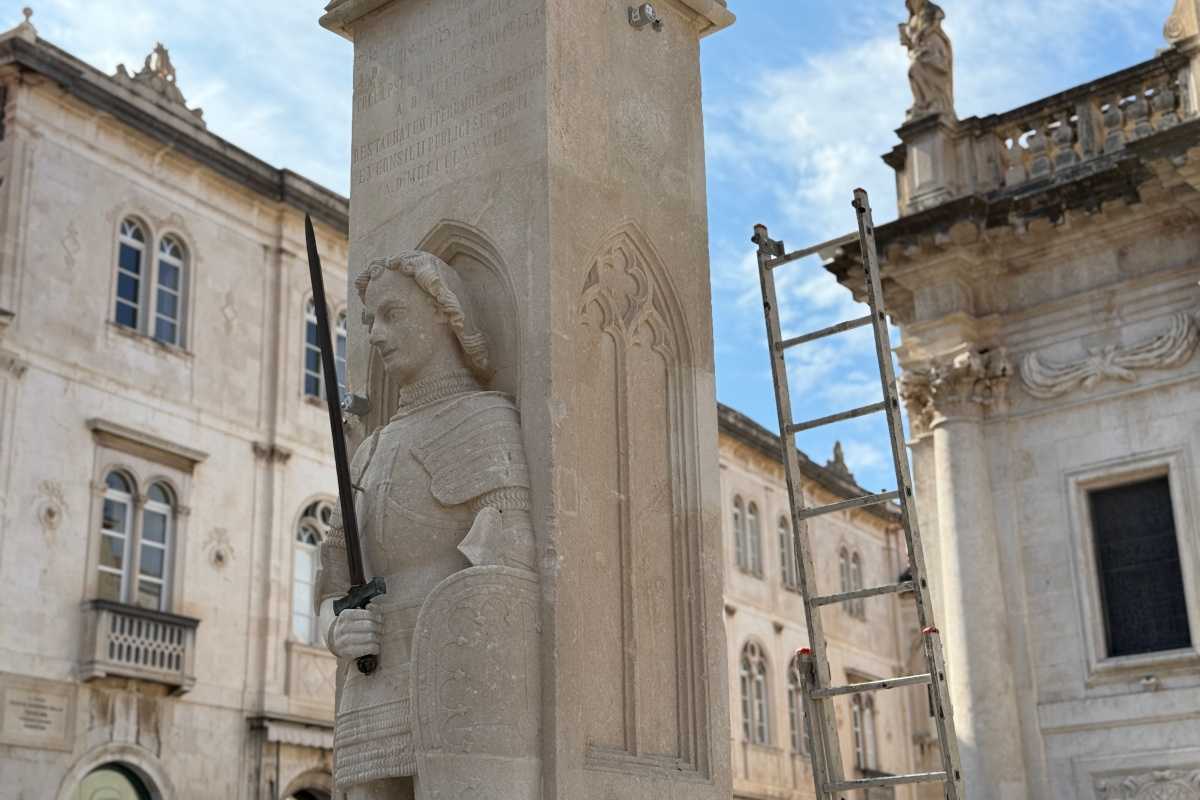
A fragile hero carefully protected
In recent years, however, Dubrovnik’s stone knight needed protection himself.
The conservation project around Orlando’s Column was launched after experts observed the worrying spread of cracks in the stone. The work, carried out over several phases, brought together the City of Dubrovnik, the Institute for the Restoration of Dubrovnik, the Croatian Conservation Institute, conservators and international experts.
A key part of the process was the careful release of pressure from a pre-stressed central metal pin installed during earlier interventions in 2006 and 2007. After several attempts using different methods, the nut and anchor plate were successfully removed in spring 2025, significantly reducing the risk of further damage.
The final phase is now focused on analysing how the column behaves after the intervention, completing work on the stone and establishing a system of permanent monitoring.
In other words, Orlando is free from the heavy scaffolding, but he is still being carefully watched over.
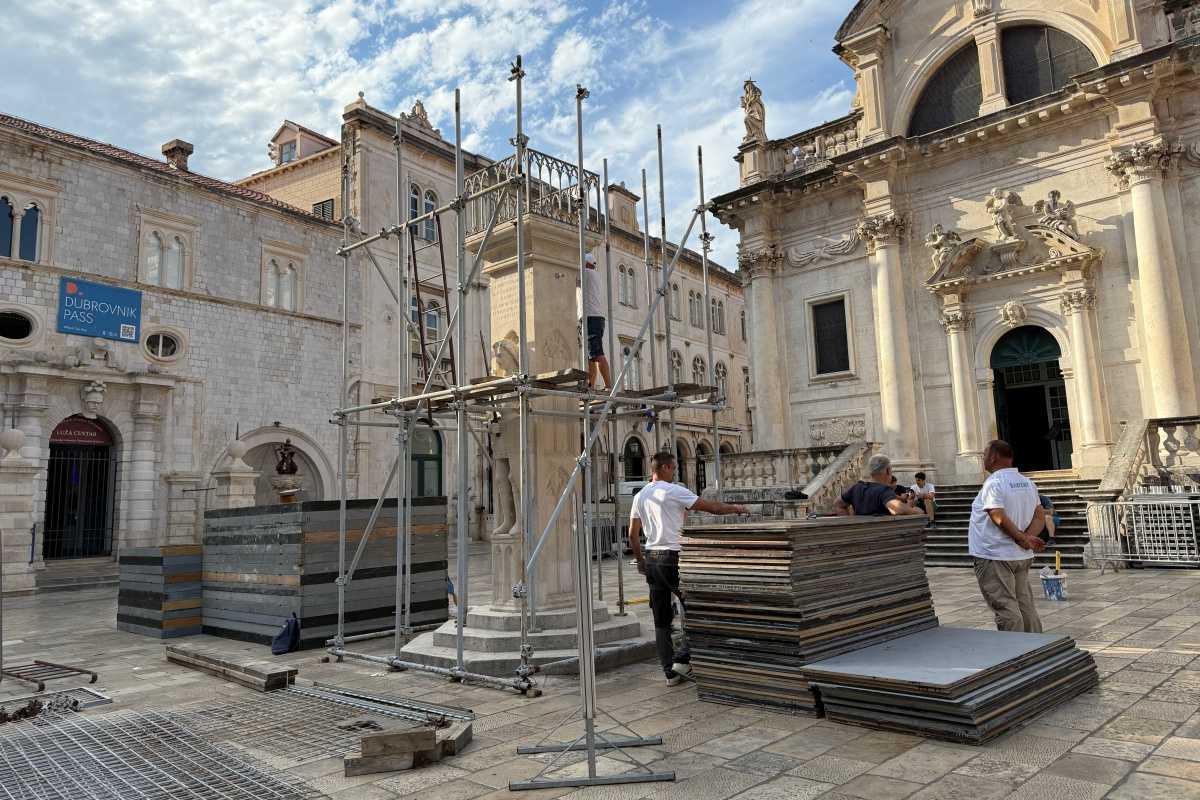
More than a monument
For visitors arriving in Dubrovnik this summer, Orlando’s return to view will be one of those small discoveries that make the Old City feel even more alive.
For locals, it is something more intimate.
Orlando has stood in Luža Square for more than six centuries. He has seen processions and proclamations, festivals and silences, war and restoration, tourists and generations of Dubrovnik families walking across the same polished stone.
Today, he can be seen again.
And in a city that has always known how to turn history into feeling, the sight of Orlando without scaffolding is more than a beautiful photo opportunity. It is a reminder of what Dubrovnik has always held closest: freedom, resilience and memory carved in stone.